
Our Family's Journey Through Time

Margaret Hook, Harry's great grandmother, emigrated with her parents and siblings from Tenterden in Kent, England, embarking 22 July 1842 on a ship for Quebec. From there, the family eventually dispersed, some remaining in Canada and some migrating to the U.S. Their story is representative of many other families who were deported from England under the authority of orders issued by the Poor Law Commissioners. Margaret's ancestors had lived for generations in an area known as The Weald, but their luck ran out and they were forced to leave their familiar home, sail for weeks in deplorable conditions, and find a new life in an unknown land.
Image: Poor people coming to a workhouse for food, c. 1840
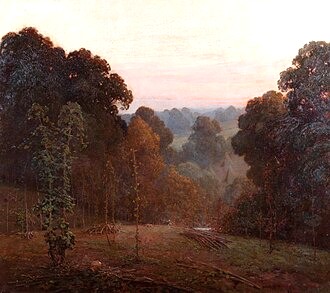
The Romans made little use of the dense forest, known to them as Silve Anderida, and their settlements remained at the edges of the deep woods. They constructed one narrow road throught the forest at its narrowest part.
The Saxons were the first to breach the forest walls. The forest was already home to the wild hog, and it was natural for Saxon swineherds living on the edge of the forest to let their hogs forage on acorns and oakmast in the forest. The swineherds let the hogs run free until confusion motivated them to define enclosures to create separate hog pastures, known by the Saxon term “dens.” The term remains part of the names of many modern settlements in Kent as a reminder of their early forest inception. For example, several of our Weald ancestral villages reflect their origin as pig pastures in The Weald: Benneden, Marden, Newenden, Rolvenden and Tenterden. Within Sussex the village names used other woodland terms such as “hurst” rather than “den.” We have ancestral ties to Wadhurst in Sussex and Hawkhurst in Kent near the East Sussex border.
Image: Autumn, Weald of Kent, painting by Benjamin Haughton
The Hook family emigrated from Tenterden to Quebec, Lower Canada. They left under the authority of orders issued by the Poor Law Commissioners. The following members of the family embarked July 22, 1842:
Although the official document does not list the name of the ship the Hook family sailed on, a notice in The Kentish Gazette reports:
“The fine first class Teak-built coppered Ship ELIZA, 600 tons burthen, Captain Vandercord will Embark Passengers at GRAVESEND, on FRIDAY, 22d. JULY, with strict punctuality and proceed direct to QUEBEC and MONTREAL. Apply to Carter and Bonus, 11, Lendenhall-street, London.”
Likewise, the Montreal Gazette arrival list at the Port of Quebec reports:
“Sept. 17. Bark Eliza, Vanderwood, 56 days, London, Chalmers & McKinnon, general cargo, 81 passengers.”
A.C. Buchanan, Chief Agent, Emigrant Department, Quebec reported on 19 September, 1842:
“Emigrants arrived this week consist of labourers, farmers and mechanics, and have landed generally in good health. All have proceeded to Canada West.”
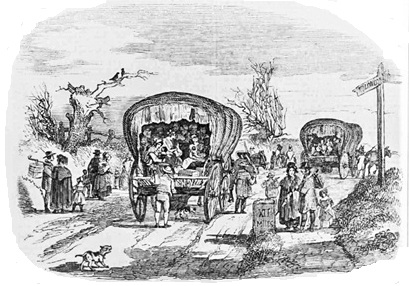
Image: The Immigrants' Farewell
On 8 August 1842, Agent Buchanan had reported:A description of another group of Poor Law Emigrants indicates that the family would have ridden in a cart along with several other people through Cranbrook to the port at Gravesend. What were they feeling? Were they sad to leave their home? Were they hopeful for a more secure future? Were they simply going with the flow of life accepting life as it was? Whatever they felt, the entire experience must have been very stressful and uncomfortable. Then to be aboard a cargo ship with seventy-plus other people in less than accommodating circumstances for 56 days would have only added to the discomfort and stress.
While living in Canada, Margaret Hook married a young Scottish immigrant, John McCauley. He became a minister, and his ministry led him to Iowa in the spring of 1877. He eventually arrived at Red Oak, Iowa where he served for nearly three years. The McCauley Family story will be linked here.
We strive to document all of our sources in this family tree. If you have something to add, please let us know.


